There’s a popular line of thinking right now that product management might be dead.
The argument goes something like this:
What do you need a PM for when AI can write a better PRD?
What do you need a PM for when AI can scour the internet, summarize customer feedback, identify UX gaps, map user flows, analyze competitors, generate tickets, and produce executive-ready updates?
What do you need a PM for when you no longer need a human meat shield standing between the team and all the reporting, presenting, explaining, status-updating, roadmap-defending, and general organizational nonsense that tends to accumulate around product development?
The argument is wrong.
Or maybe more precisely: I think it’s right about a lot of what PMs spend their time doing, but wrong about what product management actually is.
AI is not eliminating the need to know what we’re doing, why we’re doing it, how we’re going to do it, and when. Those questions are not going away.
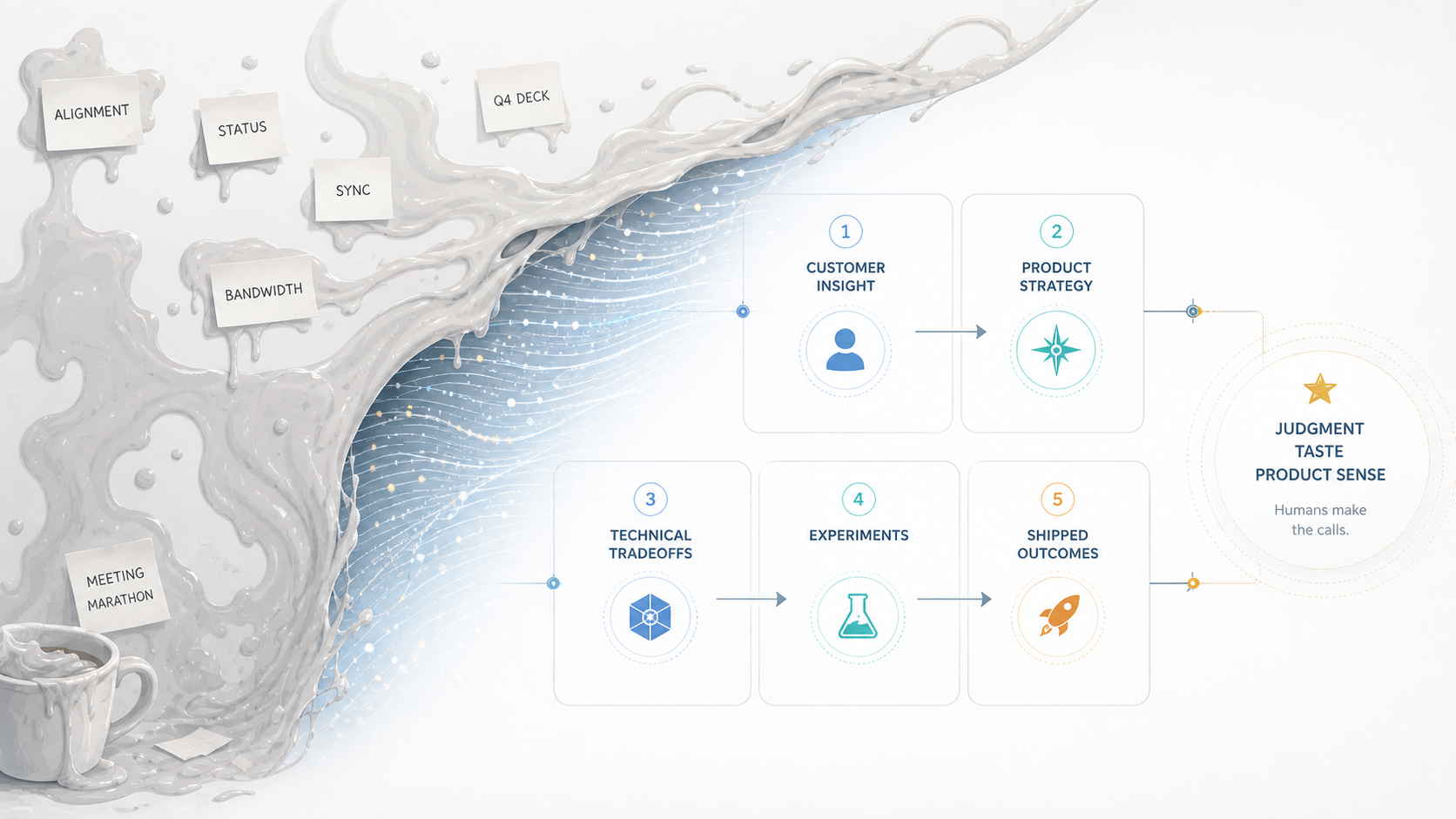
What AI is really doing is separating the wheat from the chaff. A lot of the busy work of product management is going away. The reporting, the summarizing, the Jira hygiene, the doc formatting, the status updates, the synthesis theater, the endless production of artifacts that make everyone feel like product work is happening.
Doug Harrington, the CEO of Amazon Stores, once described a lot of this kind of organizational sludge as “goo.” Every company has goo, and it was often the PM who cleaned it up.
The goo turns good PMs into project/program managers, slowing them down and distracting from the real work. Inversely, it rewards people who are good at looking buttoned up, who write the cleanest weekly updates, but lack sharp judgment.
AI is very good at goo. That’s a problem for PMs whose main value was producing it. It’s a huge unlock for PMs whose main value was always somewhere else.
The real work was never the PRD
People like to use the PRD as the obvious example. The hard part of product management was never writing a PRD. The hard part was knowing whether to write one in the first place.
What problem is humanity suffering from? With limited time/energy/resources, why this problem instead of another? Can someone else solve this problem so that we don’t have to? What do we believe about the world that others don’t or can’t? Will this still be true 10 years from now? What could we learn that would change our mind? What is the smallest version that would teach us something useful?
AI can help with all of that. Maybe get you 90% of the way there. But it does not remove the need for judgment to get that last 10%. Now that everyone can generate a decent-looking plan/roadmap/strategy, AI raises the premium on judgment.
This is a much less forgiving world.
Good PMs are going to look like they have superpowers
The best PMs are going to become dramatically more effective. In the past, PMs with strong product sense and intuition, true empathy, technical chops, good judgment, and a keen sense of humanity were often bogged down by goo, the tax you paid to operate at scale. Now, PMs can spend more of their time on the real work.
Again, the inverse is also true. In the past some PMs were considered good because they were good at the mechanics of product management. They wrote clean docs. They ran tight meetings. They followed up. They kept the roadmap updated. They made leadership feel informed. AI can do a large portion of that work faster, cheaper, and with fewer complaints.
Some of the AI talking heads are currently calling the difference between these PMs “taste”. Good PMs have always had taste.
So have good designers.
So have good engineers.
So have good operators.
The difference is that, historically, they also had to spend a lot of time doing other lower-value but necessary work. Now AI can absorb more of that work, which means taste becomes more visible.
The best people will look much better. The mediocre people will have fewer places to hide.